


Home / / Photo / Sculptures / Curatorial Projects / Bio / Contact
> stills and quotes
> reviews
> trailer
The 49th Year
88 min film / 37 min exhibition version, 2026
It is said that the social standards of a country can be understood by looking inside their prisons—that a prison is a mirror that reflects society. From the moment I get up and go to the factory until I return to my cell, I’m managed very systematically; in other words, this is an extremely supervised society. (Toshihiko Kamata, 1999)
Japanese anarchist activist Toshihiko Kamata was said to have led the Black Helmet Group which carried out a series of bombings of local police outposts in Tokyo and an US military facility in Sendai in 1971. After the violent suppression of the student movement in Tokyo and the failure of the opposition to the Japanese-American security pact, the radical leftist group resorted to a bomb struggle as a propaganda tool against state power and Japan's involvement in the Vietnam War. Their most violent attack was the so-called "Christmas Tree Bombing" on the Oiwake police outpost in Shinjuku, which injured seven people, some seriously. In 1980, after eight years in hiding, Kamata was arrested and sentenced to life imprisonment. He remains incarcerated in Miyagi Prison. So far, all requests for parole have been denied.
Kamata’s letters tell of his militant past, his present life in prison and are critical observations of the state of Japanese society and the Western world. They chronicle how labor, social relations and communication have changed over the past 46 years since his imprisonment. In his singular philosophical and poetic style, he shows us not only the harsh reality of prison life, but also shares his thoughts and dreams.
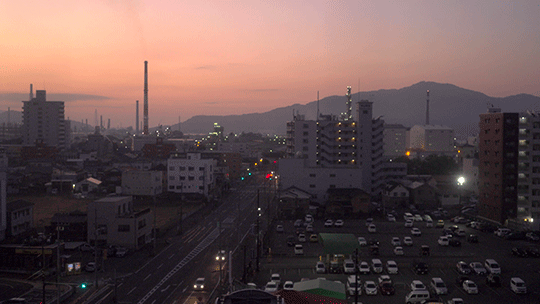
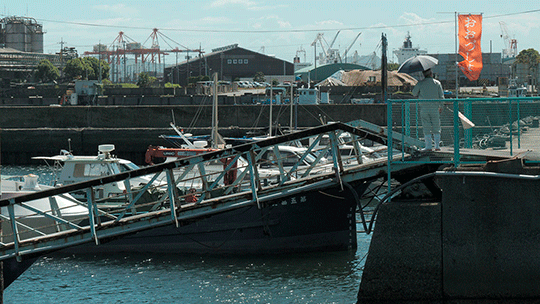
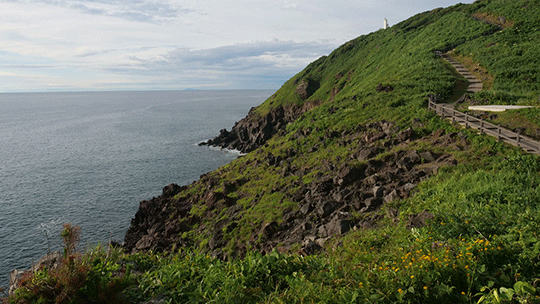
In the film fragments of his philosophical and poetic reflections spanning the five decades since the bombing resonate in landscapes connected to his story and to ongoing protest in Japan.
In a dense choreography of images, sounds and spoken texts, the film offers an intimate glimpse into the everyday life of a political prisoner in Japan and his complex intellectual universe in isolation. The 49th Year examines the relationships between social invisibility and power, subjectivity and ideology, individual action and political change. Writing as a strategy of resistance, and a form of participation in society.
**winner of the Hot Docs Joan VanDuzer Special Jury Prize-International Feature Documentary 2026**
Japanese language version & German language version, English subtitles
directed and produced by Heidrun Holzfeind
co-produced by Mariko Mikami, Koyo Yamashita
text: Toshihiko Kamata
camera: Yoshio Kitagawa, Heidrun Holzfeind
additional camera: Yukiko Iioka, Miki Shigenori, Neo Sora, Borjana Ventzislavova
editing: Bettina Blickwede, Heidrun Holzfeind
sound: Young Chang Hwang, Gerhard Funabik-Senz, Kenshi Sugita, Taku Unami
sounddesign: Gerhard Funabiki-Senz
mix: Jochen Jezussek
color grading: Till Beckmann
music: Ahousen
Japanese voice over: Makiko Watanuki
German voice over: Thomas Schultz
English translations: Norie Fukuda-Matsushima
German translations: Sabine Mangold
research, coordination, advice: Makiko Watanuki, Norie Fukuda-Matsushima
line producers: Norie Fukuda-Matsushima, Keijiro Suzuki, Hanae Takahashi
editing assistants: Andrei Barza, Akira Kawasaki, Nathalie Seidl
graphic design: Karin Holzfeind
additional music: Sabu Orimo, Shizuko Orimo, Toshio Orimo
financial support: Federal Ministry for Housing, Arts, Culture, Media and Sport Austria; Robert Bosch Stiftung & Literarisches Colloquium Berlin; Arts Council Tokyo; Berlin Senate Department for Culture and Social Cohesion; Land Tirol; Land Kärnten; Film i Västerbotten; Austrian Cultural Forum Tokyo
> pr
-