


Home / / Photo / Sculptures / Curatorial Projects / Bio / Contact
> stills and quotes
> installation views
> publication
> reviews
NEWS FROM K / THE 49TH YEAR exhibition project
37 min video, photographs, books, archive materials, color copies, boxes, 2023–2026
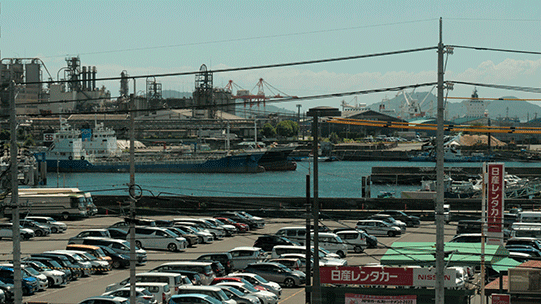
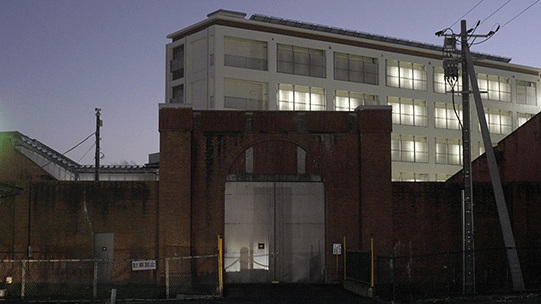
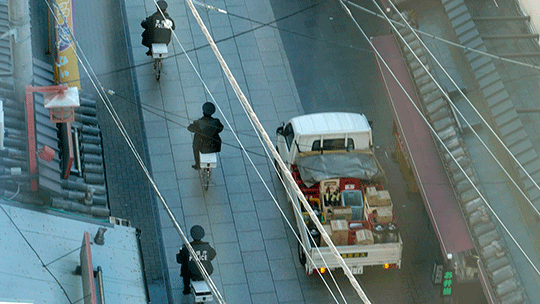
The exhibition brings together a 37 min version of the film The 49th Year, photographs, maps, books and archive materials.
Japanese activist and anarchist Toshihiko Kamata was the supposed leader of the Black Helmet Group, a loose coalition of non-sectarian leftists that carried out a series of bombings targeting police outposts in Tokyo in 1971, amid the struggles over the US-Japan Security Treaty, the Vietnam War, and student rights. After eight years in hiding, Kamata was arrested in 1980 and sentenced to life imprisonment. His letters from prison reflect on his militant past and his present life behind bars, while offering critical observations on the social and political conditions both within and beyond the prison walls and national borders.
In the film, fragments of his philosophical and poetic reflections spanning almost half a century of imprisonment resonate in contemporary landscapes filmed across Japan along his trajectory. Drawing on the idea of “landscapes as a power device” (*1), the film reveals echoes and remnants of state authority and youthful rebellion, as well as ongoing protest and the quiet presence of ordinary life—workers, older citizens, children, wild animals and other inconspicuous beings. Their mere being-there, held within the camera’s patient gaze, becomes a form of silent dissent in the face of widening social inequalities, pervasive surveillance, and expanding state power in an ageing, hyper-capitalist society. The film’s telling also shifts subtly: the letters are voiced by a woman, social activist Makiko Watanuki, Kamata’s longtime supporter and pen-pal. Thereby, reshaping the historically male-dominated narratives around landscape theory and political struggle in the 1960s and 1970s.
Alongside the film, corresponding materials are presented including photographs Holzfeind captured across Japan of places connected to Kamata’s struggle, maps that trace Kamata’s footsteps, trial documents, copies of zines published in support of Kamata during his trial in the 1980ies, and a small fraction of books that he has read in prison over the years.
The exhibition delves beyond the aftermath of the bombings, exploring the convoluted past that led the assailant to resort to such extremes and casting doubt on the efficacy of the current legal system. Through its nuanced choreography of images, sounds, and spoken texts, the work explores isolation and power, work and aging, and the possibilities for social participation even when freedom of movement is severely restricted.
(Mariko Mikami)
*1 Masao Matsuda, Fukei no Shimetsu (The Extinction of Landscape), Tabata Shoten, 1971.
First presented at ASAKUSA gallery Tokyo under the title NEWS FROM K, December 2023 and redeveloped for the ASAKUSA Pavilion at Gwangju Biennale 2026 as THE 49TH YEAR
Related Events during the exhibition NEWS FROM K at ASAKUSA gallery in 2023:
Talk and discussion with former Black Helmet Group members, October 30, 2023 18:30-20:30
The event invites former members of the Black Helmet Group to discuss the Christmas Tree Bombing Incident and their activities and philosophies that led up to it for the first time in public.
Books from Prison
While the internal conditions of Japanese prisons remain largely obscure, one can ask what makes the significance of reading in prison.
On the last two days of the exhibition, December 2 and 3, 2023, a used book fair took place, making Mr. Kamata's books available to the public.
The proceeds of books sales were used to buy new books for Mr. Kamata.
Organizer: “Sobo” Editorial Team
Exhibition 'Heidrun Holzfeind: News from K'
27 October - 3 December, 2023
ASAKUSA, 1-6-16 Nishiasakusa, Taito, Tokyo, 111-0035
In Collaboration with: Toshihiko Kamata, Makiko Watanuki, Koyo Yamashita, Norie Fukuda
gallery assistence: Gamze Baktir
Japanese activist and anarchist Toshihiko Kamata was the supposed leader of the Black Helmet Group, a loose coalition of non-sectarian leftists that carried out a series of bombings targeting police outposts in Tokyo in 1971, amid the struggles over the US-Japan Security Treaty, the Vietnam War, and student rights. After eight years in hiding, Kamata was arrested in 1980 and sentenced to life imprisonment. His letters from prison reflect on his militant past and his present life behind bars, while offering critical observations on the social and political conditions both within and beyond the prison walls and national borders.
In the film, fragments of his philosophical and poetic reflections spanning almost half a century of imprisonment resonate in contemporary landscapes filmed across Japan along his trajectory. Drawing on the idea of “landscapes as a power device” (*1), the film reveals echoes and remnants of state authority and youthful rebellion, as well as ongoing protest and the quiet presence of ordinary life—workers, older citizens, children, wild animals and other inconspicuous beings. Their mere being-there, held within the camera’s patient gaze, becomes a form of silent dissent in the face of widening social inequalities, pervasive surveillance, and expanding state power in an ageing, hyper-capitalist society. The film’s telling also shifts subtly: the letters are voiced by a woman, social activist Makiko Watanuki, Kamata’s longtime supporter and pen-pal. Thereby, reshaping the historically male-dominated narratives around landscape theory and political struggle in the 1960s and 1970s.
Alongside the film, corresponding materials are presented including photographs Holzfeind captured across Japan of places connected to Kamata’s struggle, maps that trace Kamata’s footsteps, trial documents, copies of zines published in support of Kamata during his trial in the 1980ies, and a small fraction of books that he has read in prison over the years.
The exhibition delves beyond the aftermath of the bombings, exploring the convoluted past that led the assailant to resort to such extremes and casting doubt on the efficacy of the current legal system. Through its nuanced choreography of images, sounds, and spoken texts, the work explores isolation and power, work and aging, and the possibilities for social participation even when freedom of movement is severely restricted.
(Mariko Mikami)
*1 Masao Matsuda, Fukei no Shimetsu (The Extinction of Landscape), Tabata Shoten, 1971.
First presented at ASAKUSA gallery Tokyo, December 2023 and redeveloped for the ASAKUSA Pavilion at Gwangju Biennale 2026Related Events during the exhibition NEWS FROM K at ASAKUSA gallery in 2023:
Talk and discussion with former Black Helmet Group members, October 30, 2023 18:30-20:30
The event invites former members of the Black Helmet Group to discuss the Christmas Tree Bombing Incident and their activities and philosophies that led up to it for the first time in public.
Books from Prison
While the internal conditions of Japanese prisons remain largely obscure, one can ask what makes the significance of reading in prison.
On the last two days of the exhibition, December 2 and 3, 2023, a used book fair took place, making Mr. Kamata's books available to the public.
The proceeds of books sales were used to buy new books for Mr. Kamata.
Organizer: “Sobo” Editorial Team
Exhibition 'Heidrun Holzfeind: News from K'
27 October - 3 December, 2023
ASAKUSA, 1-6-16 Nishiasakusa, Taito, Tokyo, 111-0035
In Collaboration with: Toshihiko Kamata, Makiko Watanuki, Koyo Yamashita, Norie Fukuda
gallery assistence: Gamze Baktir
English: https://www.asakusa-o.com/en/news-from-k/
Japanese: https://www.asakusa-o.com/news-from-k/
Supported by: Arts Council Tokyo (Tokyo Metropolitan Foundation for History and Culture), Federal Ministry for Art and Culture Austria, Female Artist Grant of the Senate of Berlin
-