


Home / / Photo / Sculptures / Curatorial Projects / Bio / Contact
> stills and quotes
> reviews
> trailer
On The 49th Year. Kamata’s Letters from Prison by Heidrun Holzfeind
ESTHER BUSS
Since his arrest in 1980, Toshihiko Kamata – a former left-wing extremist now in his eighties – has communicated with the outside world almost exclusively through letters. No visual record exists of the past fifty years: neither of the various prison cells in which he has spent his life, nor of the man himself. Kamata, who in the aftermath of the violent suppression of student protests in the early 1970s co-founded a militant group known as the “Black Helmet Group”, is all but invisible – absent, too, from the collective memory of Japanese society, which turned increasingly inward following those politically turbulent years.
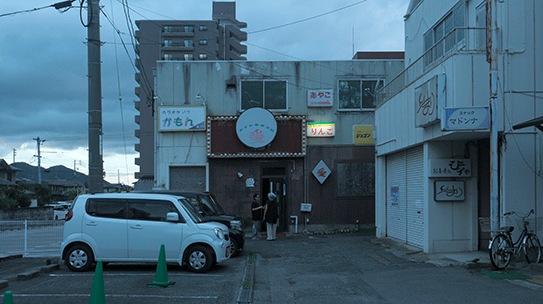
Heidrun Holzfeind approaches these multiple absences through an essayistic meditation on contemporary Japan. Tracing Kamata’s written correspondence, excerpts of which are read aloud as voice-over, The 49th Year. Kamata’s Letters from Prison visits places more or less directly connected to his story: from the port of Tokuyama, Kamata’s temporary refuge and today a major center of the chemical industry, to the area surrounding Miyagi Prison in Sendai, where he continues to serve his life sentence – with no prospect of early release.
In Kamata’s letters, distributed via his brother and the activist Makiko Watanuki to a network of supporters and friends, memoir, diary entry and contemporary diagnosis converge. Accounts of the years spent as a fugitive – living on an empty stomach in run-down lodgings – sit alongside the recounting of that fateful day when the Black Helmets carried out a bomb attack on a local police outpost in Tokyo’s Shinjuku district. Observations of snowflakes outside his cell window alternate with reflections on prisons as engines of cheap labor and on the end of history.
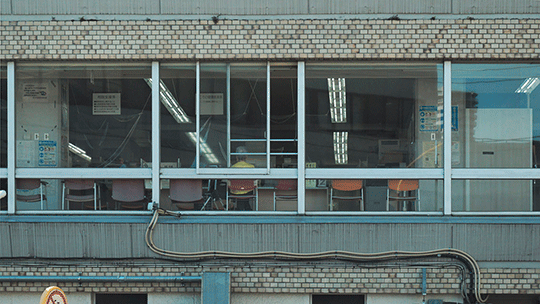
Image and text move along different timelines and yet reverberate in one another. Moving beyond representational depiction, Holzfeind searches for images in which political power and control manifest themselves in public space: anonymous streets and squares, the omnipresence of surveillance cameras, the thoroughgoing commodification of urban life. The camera repeatedly allows itself to be shaped by the visual logic of control technologies – through surveillance perspectives and zooms. The present inscribes itself into historical sites – and vice versa. At the site of the bombing, a busy street corner, a luxury fashion flagship store stands today. Even apparently “innocent” nature is not unmarked: in the densely wooded area around Mount Chokai, Kamata trained with the Black Helmet Group for armed resistance.
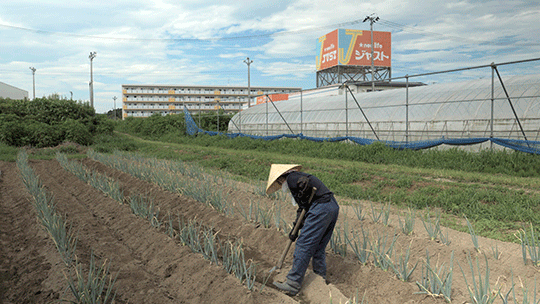
Almost imperceptibly, the cold, anonymous visual world in which Kamata’s “life on the assembly line” is reflected becomes more porous. Children and young people begin to enter the frame, lives on the margins of society, and forms of resistance: a protest sign outside a laborers’ welfare center in Sanya, Tokyo, opposing the discharge of contaminated water into the sea; or the blockade mounted by a local farmer literally “sitting” his ground against the expropriation of his land for the expansion of Narita Airport – one of the most protracted and violent social conflicts in postwar Japan. Meanwhile, Kamata comments on the installation of cable television in Miyagi Prison, the arrival of a “revolutionary” karaoke machine, and, before long, the election of Donald Trump.
In one of his countless letters, Kamata quotes the poet Federico García Lorca: “At some point we all find ourselves travelling aboard a vast airship in a storm.” The 49th Year. Kamata’s Letters from Prison unfolds in quiet, composed movements, yet bears witness to the profound disruptions that capitalism and disciplinary power have left on Japanese society.
Translation: Lian Rangkuty
-